
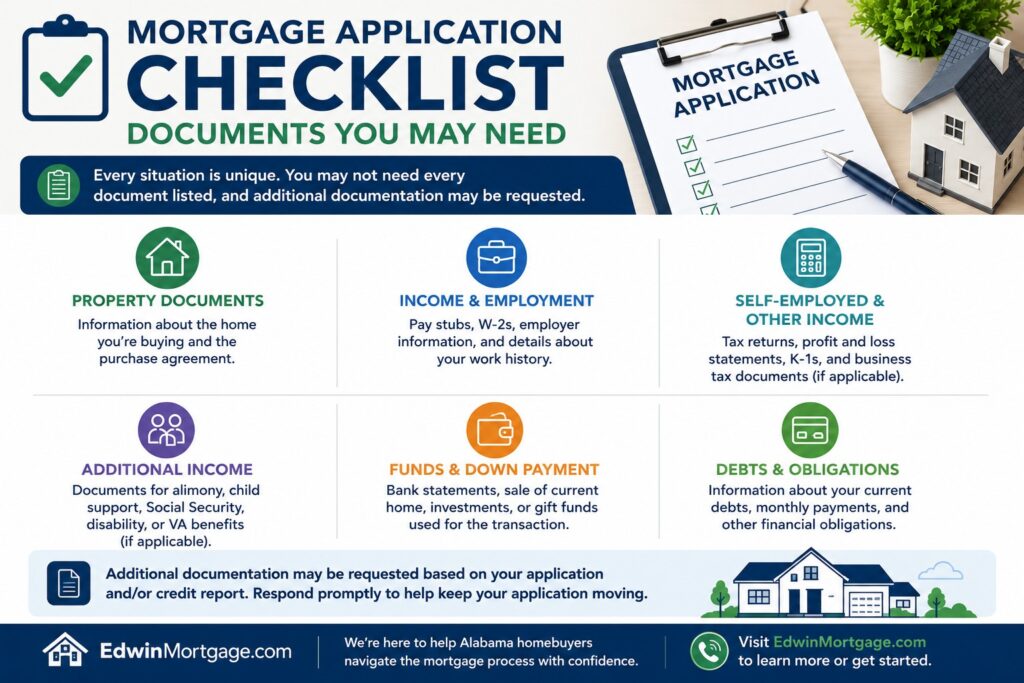
Mortgage Application Checklist
What You May Need to Apply for a Home Loan
Applying for a mortgage involves more than choosing a home and completing an application. You may also need to provide documents that help your mortgage professional understand your income, assets, debts, source of funds, and the property you plan to purchase.
For first-time homebuyers, some of this paperwork may be unfamiliar. Even experienced homeowners may find that the documents requested for one mortgage are different from those requested for another.
That is why getting organized early can be helpful.
Whether you are buying a home in Oxford, Anniston, Birmingham, Huntsville, Auburn, Montgomery, or another Alabama community, knowing which documents may be requested can make the mortgage application process easier to follow.
This mortgage application checklist from EdwinMortgage.com provides a practical starting point.
Keep in mind that every mortgage situation is unique. You may not need every document listed below, and additional information may be requested based on your individual circumstances.
What Documents Do You Need to Apply for a Mortgage?
Mortgage applicants may need to provide documents covering several areas of their finances and home purchase. These can include information about the property, income and employment, assets and down-payment funds, existing debts, and other sources of income.
For example, an employed borrower may be asked for recent pay stubs and W-2 forms, while a self-employed borrower may need additional tax and business documentation. Buyers may also need to document where their funds for the transaction are coming from.
The exact mortgage application documents you need can vary, so use this checklist as a preparation guide rather than a guarantee that every item will apply to you.
Mortgage Application Checklist
Use this quick mortgage paperwork checklist to start organizing the documents that may apply to your situation.
Property Documents
Depending on your transaction, you may need:
- Copy of the signed sales contract, including all riders
- Verification of the deposit you placed on the home
- Names, addresses, and telephone numbers of the realtors, builders, insurance agents, and attorneys involved
- Copy of the listing sheet, if available
- Legal description of the property, if available
- For a condominium, the condominium declaration, bylaws, and most recent budget
These documents provide information related to the property and purchase transaction.
Income and Employment Documents
You may be asked to provide:
- Pay stubs covering the most recent 30-day period and year-to-date
- W-2 forms for the past two years
- Names and addresses of employers for the last two years
- A letter explaining any gaps in employment during the past two years
- A copy of your work visa or green card, front and back, when applicable
Gathering these records in advance can help you respond when employment or income documentation is requested.
What Documents May Self-Employed Borrowers Need?
Documentation can look different when a borrower is self-employed or receives certain types of income.
If you are self-employed or receive commission, bonus, interest/dividend, or rental income, the supplied mortgage application checklist calls for additional documentation that may include:
- Full tax returns for the last two years
- A year-to-date Profit and Loss statement
- Complete tax returns, including attached schedules and statements
- A copy of your tax-filing extension if you filed an extension
- K-1s for partnerships and S-Corporations for the last two years
Completed and signed Federal Partnership Form 1065 and/or Corporate Income Tax Returns Form 1120, including schedules, statements, and addenda, when applicable
For the business-return documentation described above, the supplied checklist states that it is required when the borrower’s ownership position is 25% or greater.
One practical tip is to check your tax returns carefully for K-1s. The source material notes that K-1s may not be attached to the individual Form 1040.
Because individual circumstances differ, ask your mortgage professional which documents apply to your particular income structure.
What If You Use Alimony or Child Support to Qualify?
If alimony or child support will be used as qualifying income, the checklist identifies two types of documentation:
- Divorce decree or court order stating the amount
- Proof that the funds were received during the last year
This section applies specifically when alimony or child support is being used to qualify.
If you pay rather than receive alimony or child support, documentation of that obligation may also be requested, as discussed in the debt section below.
What If You Receive Social Security, Disability, or VA Benefits?
If you receive Social Security income, disability benefits, or VA benefits, you may be asked to provide:
- An award letter from the applicable agency or organization
Keeping your current award documentation accessible can make it easier to provide when requested during your mortgage application.
What Documents May Be Needed to Verify Your Down Payment and Funds?
Your mortgage application may require documentation showing the source of money being used in the transaction.
The documentation can depend on where your funds are coming from.
Selling Your Existing Home
If funds will come from the sale of your current residence, you may need:
- Copy of the signed sales contract for your current residence
- Statement or listing agreement if the property remains unsold
- Settlement or Closing Statement at closing
Savings, Checking, or Money Market Funds
If you are using funds held in savings, checking, or money market accounts, the checklist calls for:
- Copies of bank statements for the last three months
Stocks and Bonds
If your funds involve stocks or bonds, you may need:
- Statements from your broker
or
- Copies of certificates
Gift Funds
If a gift will be part of your cash to close, you may need:
- Gift Affidavit
- Proof of receipt of the funds
The source of funds is an important area to organize carefully because the supplied checklist also notes that additional documentation may be requested based on information appearing on your application and/or credit report.
What Debt Information May Be Requested?
Your mortgage documentation may also include information about your existing debts and financial obligations.
Prepare information including:
- Names associated with current debts
- Addresses
- Account numbers
- Current balances
- Monthly payments
- Copies of the last three monthly statements
The checklist also calls for the names, addresses, account numbers, balances, and monthly payments associated with mortgage holders and/or landlords for the last two years.
If you are currently paying alimony or child support, you may also need:
- Marital settlement agreement or court order stating the terms of the obligation
Having this information organized can make it easier to respond when details about your existing obligations are requested.
Why Should You Organize Mortgage Documents Early?
A mortgage application can involve information from several different sources. Some documents may already be easy to access online, while others may require contacting an employer, accountant, broker, attorney, or another party.
Creating a dedicated folder—digital, physical, or both—for your mortgage application paperwork can make it easier to keep track of what you have available and what has been requested.
For example, you might separate documents into folders for:
- Property
- Employment and income
- Tax documents
- Bank and investment accounts
- Down-payment funds
- Debts and obligations
- Additional income documentation
The goal isn’t to send every financial document you have. Instead, stay organized so you can provide applicable information when your mortgage professional requests it.
Does Every Mortgage Applicant Need the Same Documents?
No. Every mortgage situation is unique.
A salaried employee buying a home may have a different documentation package than a self-employed borrower. Someone using proceeds from the sale of an existing home may have different source-of-funds documentation than a buyer using savings or gift funds.
Your property can also affect the documents involved. For example, the supplied checklist includes additional property documentation for condominium purchases.
The best approach is to treat a mortgage application checklist as a preparation tool—not a universal list of documents every borrower must submit.
If additional documentation is requested, being cooperative and providing the requested information as soon as possible can help keep the application process moving.
Preparing for a Mortgage Application in Alabama
If you’re preparing to buy a home in Alabama, organizing your mortgage application documents is one task you can tackle before or during the application process.
A first-time buyer in Oxford or Anniston may need help understanding unfamiliar mortgage paperwork. A buyer moving to Birmingham or Huntsville may already have several financial accounts to organize. Someone buying in Auburn, Montgomery, Gadsden, Mobile, Tuscaloosa, or another Alabama community may have a completely different financial situation.
The location may change, but the organizational principle remains useful: know where your relevant property, income, asset, and debt documentation is located and be prepared to provide applicable documents when requested.
If you’re researching Alabama home loans or preparing to speak with an Alabama mortgage professional, this checklist can give you a starting point for that conversation.
Mortgage Application Checklist FAQs
What documents do I need to apply for a mortgage?
Depending on your situation, you may need documents covering the property, income and employment, assets, down-payment funds, debts, and other sources of income. Self-employed borrowers and borrowers using certain types of income may need additional documentation. Exact requirements can vary.
How many months of bank statements may be requested?
For savings, checking, or money market funds, the supplied mortgage application checklist calls for copies of bank statements covering the last three months.
How many years of W-2s may be requested?
The checklist calls for copies of your W-2 forms for the past two years, along with pay stubs for the most recent 30-day period and year-to-date.
What documents may a self-employed borrower need?
The supplied checklist includes full tax returns for the last two years, a year-to-date Profit and Loss statement, applicable K-1s, and certain business tax returns and supporting schedules when applicable. The business-return requirement described in the checklist applies when ownership is 25% or greater.
Do I need tax returns to apply for a mortgage?
Not every item on this checklist applies to every borrower. The supplied material specifically identifies full tax returns for the previous two years for borrowers who are self-employed or receive commission, bonus, interest/dividend, or rental income. Your mortgage professional can tell you what applies to your situation.
What documents may be needed if I receive child support or alimony?
If you will use alimony or child support to qualify, the checklist calls for a divorce decree or court order stating the amount and proof of receipt of the funds for the last year.
What may be needed for Social Security, disability, or VA benefits?
The checklist calls for an award letter from the applicable agency or organization.
What documents may be needed when using gift funds?
If gift funds are part of your cash to close, the checklist identifies a Gift Affidavit and proof of receipt of the funds.
What debt information may be requested?
You may need to provide names, addresses, account numbers, balances, and monthly payments for current debts, along with copies of the last three monthly statements. Information regarding mortgage holders and/or landlords for the previous two years may also be requested.
Can a mortgage lender request additional documents?
Yes. The supplied checklist specifically notes that additional documentation may be requested based on information appearing on your application and/or credit report. Every situation is unique.
Get Organized Before Your Mortgage Application
Understanding which mortgage application documents may be requested can make the financing process easier to navigate.
Start by organizing the information that applies to your situation: your property documents, recent income records, tax or business documents when applicable, bank and investment statements, information about your down-payment funds, and details about your existing debts and obligations.
Most importantly, remember that a mortgage application checklist is a starting point. Your specific documentation needs may vary based on your circumstances, property, transaction, and loan program.
For Alabama homebuyers and homeowners who want to better understand their mortgage options and prepare for the application process, visit EdwinMortgage.com to learn more and discuss your individual situation.
This information is provided for general educational purposes. Mortgage documentation requirements vary based on the borrower, property, transaction, loan program, and other circumstances. Additional documentation may be requested. Confirm the documentation required for your individual application with your mortgage professional.

